Meet Opie AI™, the AI assistant built exclusively for pediatrics.
Be present for the visit. Be done when the day is done. Opie turns pediatric conversations into structured clinical notes, suggests E&M and ICD-10 codes, and creates clear after-visit summaries for families. Built for pediatric care and integrated with Office Practicum, it helps you stay focused on your patients, finish documentation faster, and leave your notes at the office when you head home.
.webp)
AI that understands the pediatric visit.
Opie is trained on AAP Bright Futures guidelines and Office Practicum’s pediatric templates, so it understands the nuances of well visits, sick visits, and the conversations that make pediatric care different.
Pediatric visits rarely involve just two people. Opie follows conversations between providers and families, even when multiple people or languages are involved, and turns the visit into one clear clinical note.
Opie sends discrete data directly into the appropriate chart fields, so your documentation is where you need it. It can also suggest E&M and ICD-10 codes and create a family-friendly after-visit summary.
From conversation to completed documentation. In four simple steps.
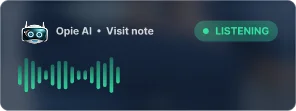
Opie listens to the entire visit, keeping track of who said what and capturing the details that matter across multiple speakers and languages.
Opie turns the conversation into structured documentation in your preferred format, with Magic Edit, dot phrases, and suggested E&M and ICD-10 codes to help you finish faster.
You stay in control. Review the draft, make any changes, and approve the final note while Opie creates a clear after-visit summary for the family.
Customize how Opie creates your notes so they match your preferences and workflow, making documentation faster and easier with every visit.
“With Opie AI, I can actually see my patients. If it did nothing else but let me look a depressed teenager in the eye and say, ‘You’re going to be okay’ — without breaking that connection to type — that alone would make it worth it.”
.webp)
Not every AI scribe understands pediatrics.
“I really like using Opie AI for behavioral health visits and those life concerns that don’t fit neatly into a template. I also appreciate how it captures side concerns and codes them alongside the main complaint — it helps document the true complexity of the visit.”
.webp)
Questions about Opie AI™ ? Start here.
Opie AI™ is a pediatric-specific AI medical scribe that listens to patient-provider conversations and automatically generates clinical documentation.
Unlike generic AI scribes, Opie AI is trained specifically for pediatric care, including AAP Bright Futures guidelines and Office Practicum’s pediatric workflows and templates. This allows it to understand the unique language, documentation requirements, and visit types commonly seen in pediatric practices.
During a patient encounter, Opie AI captures the conversation in real time and identifies key clinical information, including symptoms, exam findings, diagnoses, treatment plans, and follow-up instructions. It then organizes that information into structured visit notes that are ready for provider review.
Opie AI can also support documentation that begins during patient intake, suggest appropriate E&M and ICD-10 codes, generate clear after-visit summaries for families, and help manage multilingual conversations by translating them into a single clinical note.
The result is faster, more complete pediatric documentation that allows providers to spend less time charting and more time focused on patients and families.
Time savings vary based on provider workflow and documentation style, but many pediatricians report significantly reducing the time they spend on charting and clinical documentation.
Some studies show that providers spend more than 40% of their workday on EHR and documentation-related tasks. Opie AI™ helps reduce that burden by capturing patient-provider conversations and automatically generating structured notes during the visit. Instead of documenting encounters from scratch, providers can review, edit, and finalize notes that are already largely complete.
As a result, many practices are able to complete documentation during or shortly after patient encounters rather than spending hours charting after clinic.
By reducing documentation burden and after-hours charting, Opie AI helps providers spend less time in the EHR, reduce charting fatigue, and focus more time on patient care, family, and personal well-being.
For many pediatricians, the biggest benefit is simple: leaving the office with fewer unfinished notes and more time at the end of the day.
Yes. Opie AI™ is designed to support HIPAA compliance and includes enterprise-grade security measures to help protect patient information and protected health information (PHI).
Patient data is encrypted both in transit and at rest, and information is stored using secure, HIPAA-compliant infrastructure. Access to data is controlled through authentication and authorization protocols, and comprehensive audit trails help support security monitoring and compliance requirements.
Opie AI is built to meet the privacy, security, and data protection standards healthcare organizations expect from clinical technology. We take the security of your patient data as seriously as you do, applying the same rigorous standards and safeguards that practices expect from their EHR and other healthcare systems.
For pediatric practices, this means providers can benefit from AI-powered documentation while maintaining the security, privacy, and compliance standards required for healthcare data.
Yes. Opie AI™ is particularly effective for behavioral health visits and other complex conversations where traditional templates often fall short.
Pediatricians frequently use Opie AI during discussions about depression, anxiety, ADHD, family dynamics, and social determinants of health—conversations that require providers to stay engaged, maintain eye contact, and focus fully on the patient and family.
Opie AI captures the nuances of these conversations, including important side concerns mentioned during the visit, multiple issues addressed in a single encounter, and critical clinical context that might otherwise be missed. It also helps ensure documentation accurately reflects the complexity of the visit for coding and billing purposes.
For behavioral health visits, where human connection is especially important, Opie AI reduces the documentation burden so providers can stay present in the conversation while confidently capturing the details needed for complete and accurate clinical records.
Opie AI™ is designed to produce highly accurate pediatric documentation by combining advanced AI technology with training focused specifically on pediatric medicine, pediatric workflows, and AAP Bright Futures guidelines.
Unlike generic AI medical scribes, Opie AI understands pediatric terminology, growth and development milestones, age-appropriate anticipatory guidance, immunization discussions, common pediatric diagnoses, and the unique documentation requirements of pediatric care. This pediatric-specific training helps generate clinical notes that are both comprehensive and relevant to the patient encounter.
Opie AI is designed to support providers — not replace clinical judgment. Providers always review and approve documentation before it becomes part of the medical record. If changes are needed, notes can be quickly refined using the Magic Edit feature, customized with preferred dot phrases, or adjusted to match individual documentation styles and preferences.
Most providers find that Opie AI generates documentation that is accurate, thorough, and ready for review, requiring only minor edits rather than extensive rewriting.
The result is faster documentation, less time spent charting, and greater confidence that important clinical details are captured accurately.
Opie AI™ is designed with multiple safeguards to help ensure clinical accuracy. Providers always review and approve documentation before it becomes part of the patient record.
If Opie AI mishears or misinterprets something, corrections are simple. You can use the Magic Edit feature with natural-language commands, manually edit any section of the note, add or remove information, or adjust suggested diagnosis and billing codes.
Over time, Opie AI learns from provider feedback and corrections, helping improve accuracy and personalization. Most importantly, you remain in complete control of the final documentation. Opie AI generates a draft note for review and approval, much like working with a human medical scribe.
In most cases, providers find that Opie AI creates documentation that is approximately 90–95% complete and accurate, requiring only minor edits rather than documenting the encounter from scratch.
An AI medical scribe is an artificial intelligence-powered tool that listens to patient-provider conversations during medical visits and automatically creates clinical documentation.
Opie AI™ is an AI medical scribe built specifically for pediatric care. It is trained on pediatric medicine and AAP Bright Futures guidelines, so it understands the language, workflows, and documentation needs of pediatric practices.
During a patient visit, Opie AI captures the conversation in real time and identifies key clinical details, including symptoms, exam findings, diagnoses, treatment plans, and follow-up instructions. It then organizes that information into structured medical notes based on your preferred templates.
Opie AI can also suggest appropriate billing codes, including E&M levels and ICD-10 diagnosis codes, and generate clear after-visit summaries for families.
Unlike traditional dictation, Opie AI does not require providers to speak in a specific format. And unlike a human scribe, it does not need extensive training on your documentation style. It works quietly in the background, learns your preferences over time, and helps complete notes during or shortly after the visit.
The result is comprehensive pediatric documentation that is ready faster, so providers can spend less time charting after hours and more time focused on patients.
Traditional dictation software, such as Dragon, requires providers to dictate their notes directly into the computer. While it converts speech to text, the provider is still responsible for organizing the information, structuring the note, and documenting every clinical detail.
An AI medical scribe like Opie AI™ works differently. Instead of dictating your documentation, you simply conduct the visit as you normally would. Opie AI listens to the natural conversation between the provider, patient, and family, identifies relevant clinical information, and automatically generates structured documentation.
Opie AI can capture symptoms, exam findings, diagnoses, treatment plans, and other key details from the encounter. It then organizes that information into a clinical note based on your preferred documentation style and workflow.
The key difference is that dictation software helps you write notes with your voice, while an AI medical scribe helps create the notes for you. This allows providers to stay focused on the patient conversation rather than thinking about documentation during the visit.
The result is less administrative work, fewer after-hours charting tasks, and more time for patient care.
Dictation software helps you write notes with your voice, while an AI medical scribe helps create the notes for you.
Yes. In fact, pediatric visits are one of the areas where specialized AI medical scribes like Opie AI™ provide significant value.
Unlike many adult-focused medical encounters, pediatric visits often involve multiple participants. Providers may be speaking with a parent while engaging the child, discussing concerns with grandparents or caregivers, or navigating conversations with both an adolescent and their parent. These interactions can be complex, fast-moving, and involve multiple perspectives.
Opie AI is specifically trained for pediatric workflows and is designed to capture the clinically relevant details from these multi-party conversations. It helps identify symptoms, concerns, questions, treatment plans, and follow-up instructions while preserving the context of who said what during the visit.
Whether the discussion involves developmental concerns, behavioral health topics, chronic condition management, or routine well-child care, Opie AI helps create comprehensive documentation without requiring providers to pause the conversation or take extensive notes.
The result is more complete clinical documentation and a more natural experience for providers, patients, and families.
Documentation is one of the biggest contributors to physician burnout. Many pediatricians spend a significant portion of their day completing EHR tasks and often finish clinical notes after hours, cutting into personal and family time.
AI medical scribes like Opie AI™ help reduce this burden by automating much of the documentation process during the patient visit. Instead of spending evenings catching up on charting, providers can review and finalize notes that have already been drafted in real time.
Opie AI captures the clinical conversation, generates structured documentation, and helps organize key information while the visit is happening. As a result, notes are often completed during or shortly after the encounter rather than hours later.
By reducing administrative work and after-hours charting, Opie AI helps providers spend less time in the EHR and more time focused on patient care, family, and personal well-being.
Yes. One of the most noticeable benefits of using an AI medical scribe like Opie AI™ is that documentation is largely completed during the patient visit rather than after the workday ends.
By the time a provider leaves the exam room, Opie AI has already captured the conversation, organized the clinical information, and generated a structured note. Instead of spending 10–15 minutes creating documentation from scratch, providers typically spend just a few minutes reviewing, editing if needed, and approving the note.
While results vary based on documentation style, visit complexity, and workflow preferences, many providers find that their notes are approximately 90–95% complete by the end of the encounter.
This allows charting to happen in real time, reduces the need for after-hours documentation, and helps providers leave the office with fewer unfinished notes waiting for them at home.
For many pediatricians, that’s the biggest transformation: spending more time with patients during the day and less time catching up on charts at night.
Time savings vary based on provider workflow and documentation style, but many pediatricians report reclaiming 1–2 hours per day by reducing manual charting and after-hours documentation.
That can add up to 5–10 hours per week — roughly an extra workday that can be spent seeing patients, supporting staff, or simply getting home on time.
Opie AI™ captures patient-provider conversations and automatically generates clinical documentation during the visit, allowing providers to review and finalize notes rather than create them from scratch. By reducing documentation burden and charting time, Opie AI helps pediatricians spend less time in the EHR and more time focused on patient care.
For many providers, the biggest benefit isn’t just time savings—it’s leaving the office with fewer unfinished notes and less work waiting at home.
In many cases, providers who feel the most overwhelmed by documentation see some of the greatest benefits from using an AI medical scribe.
Much of physician burnout is linked to administrative work, EHR documentation, and after-hours charting. By automating note creation during the patient visit, Opie AI™ helps reduce the time spent documenting encounters and reviewing charts after clinic hours.
While no technology can solve every cause of burnout, reducing the documentation burden can help providers regain valuable time, improve work-life balance, and focus more of their energy on patient care.
For many pediatricians, the biggest change is simple: fewer hours spent charting and more time available at the end of the day.